When people think about rug cleaning, their minds usually drift toward the removal of dirt, the extraction of stains, or the refreshment of dull colours. They imagine soapy suds, heavy machinery, or the intensive scrubbing required to lift deep-set grime. However, the most vital phase of the restoration process happens after the washing is complete. Understanding why rug drying matters is the difference between a pristine, long-lasting textile and a ruined floor covering. At our facility in Newcastle, we view drying not as a passive conclusion to a wash, but as a dynamic, high-stakes technical procedure that dictates the structural and aesthetic integrity of the item.
If a rug is not dried with precision and speed, it can suffer from irreversible degradation. In the humid climate of the Hunter Region, where morning mists and summer humidity levels can fluctuate dramatically, the margin for error is razor-thin. Improperly treated rugs—even those that appear clean on the surface—can harbour hidden hazards within their foundations. To achieve professional results, one must treat the drying phase with the same rigour and expertise as the cleaning itself, respecting the unique chemistry of natural fibres and the complex architecture of hand-knotted or machine-made rugs.
The Science of Moisture: Why Rug Drying Matters Above All Else
Many novice cleaners or homeowners make the mistake of viewing the rug drying process as an afterthought—simply leaving the rug in a corner or hanging it over a fence to "drip-dry." This is a fundamental misunderstanding of textile science. Rugs are complex multi-layered systems. They consist of a face fibre (the pile), a foundation (the warp and weft), and often an adhesive or latex backing, especially in tufted carpets. Each of these components has a different rate of evaporation and absorption.
When a rug is saturated during the washing process, moisture penetrates deep into the heart of the foundation. If this moisture is not evacuated uniformly and rapidly, it does not simply disappear; it migrates. This movement of water through the structure of the rug can bring tannins, soil residues, and dyes along with it. This is why drying is a critical step; it is the final barrier against the degradation of the fibres and the permanent staining of the backing. When we discuss why rug drying matters, we are essentially talking about the prevention of systemic failure within the textile. A rug that stays wet for too long is a rug that is actively working against its own longevity.
The Catastrophic Risks of Poor Drying Practices
When moisture is trapped within a rug, a cascade of negative effects begins. The risks are not merely cosmetic; they are structural. One of the most common issues arising from slow drying is "browning." This occurs when cellulosic fibres (like cotton or jute foundations) are exposed to moisture for an extended period. The moisture leaches out the natural organic compounds within the fibres, bringing them to the surface, where they oxidise and leave behind unsightly yellow or brown discolouration. This is notoriously difficult to correct once it has set.
Beyond browning, there is the risk of dye migration. If the dye used in the rug is not perfectly stable, or if the water used in the wash is not controlled for pH, trapped moisture acts as a solvent. The colours can bleed from the dark areas into the light, creating a blurred or "muddy" appearance that can permanently ruin the design of a rug. Furthermore, shrinkage is a significant threat. Natural fibres like wool and cotton contract when wet and expand when dry, but if they are dried unevenly, the backing will contract faster than the pile, leading to "puckering" or distortion. A rug that was once flat will suddenly develop ripples, humps, or waves, making it impossible to lay perfectly flush on a hard floor.
Perhaps the most insidious danger of inadequate drying rugs properly is the growth of mould and mildew. Mould spores thrive in damp, dark, and warm environments—conditions found perfectly within the thick pile of a wool rug or the jute backing of an antique piece. Once mould takes hold, it consumes the natural fibres, leading to "dry rot." The rug may look fine on the surface, but the foundation will become brittle and eventually disintegrate. Associated with this is the persistent, musty odour that can permeate an entire room, signalling that the rug has never been fully sanitised.
How Professional Controlled Drying Differs from Home Methods
The distinction between home air-drying and professional controlled drying lies in the management of the environment. In a residential setting, air-drying is subject to the whims of the weather. If you are in Newcastle or the surrounding Hunter Region, you might be dealing with high coastal humidity, which prevents effective evaporation. Air-drying is essentially a passive process that relies on natural airflow; it is slow, unpredictable, and rarely penetrates the deepest layers of the rug foundation.
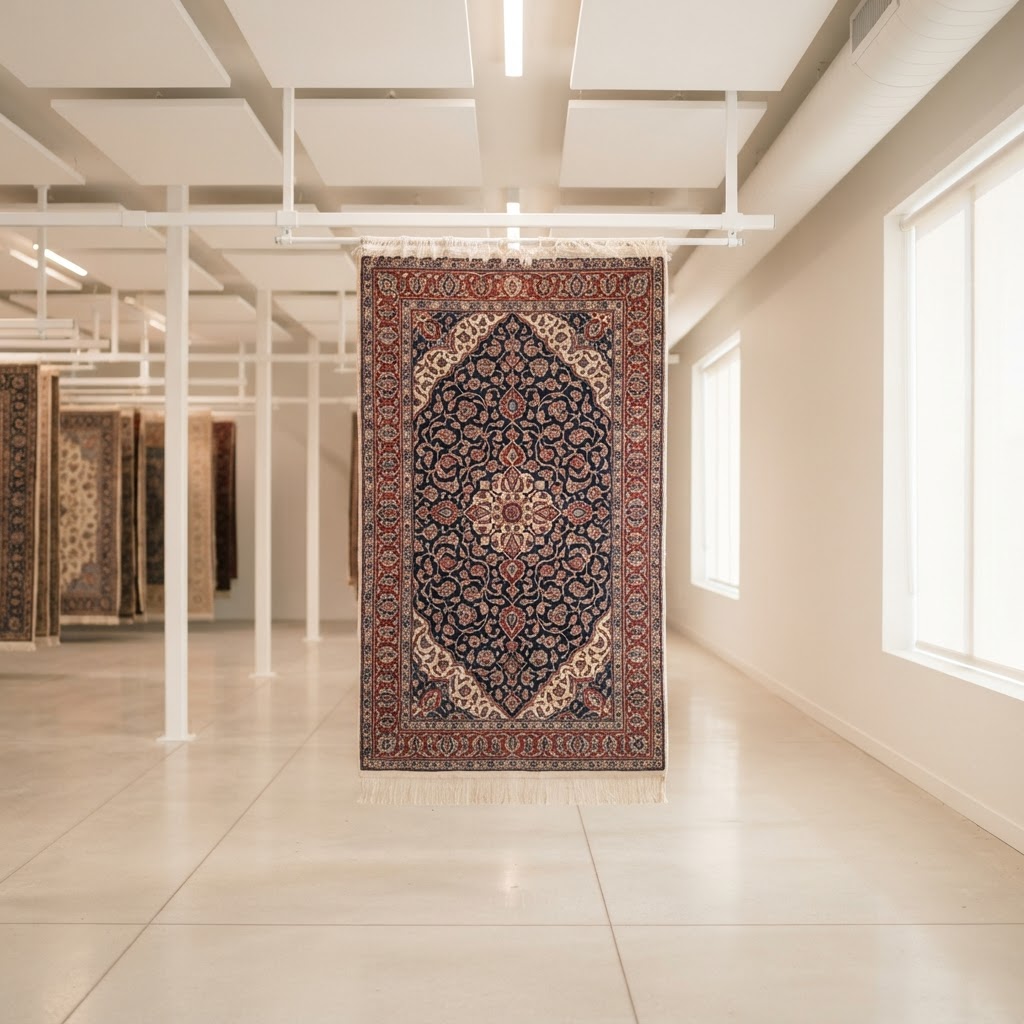
In a professional facility, we utilise a climate-controlled environment that regulates temperature, relative humidity, and airflow velocity. We do not just wait for the rug to dry; we actively engineer the conditions to ensure it happens at the optimal rate. This involves:
- Dehumidification: Reducing the moisture content in the air to encourage the rug to release its own stored water.
- Targeted Airflow: Using industrial-grade air movers to create consistent, high-volume circulation over and under the rug, preventing pockets of stagnant, humid air.
- Temperature Control: Maintaining an environment that is warm enough to speed up molecular evaporation but cool enough to prevent the degradation of protein fibres like wool or silk.
By controlling these variables, we ensure that the rug drying process is uniform. When a rug dries evenly across its entire surface area, it prevents the differential shrinkage that causes distortion. The goal is to reach a "dry-to-the-touch" state as quickly as possible, ensuring that the foundation is no longer acting as a reservoir for moisture.
The Role of Fibre Sensitivity in the Drying Lifecycle
Every rug tells a story, and its fibres dictate how we must treat it. The "Assessment Before Assumption" rule is paramount here. We cannot treat a synthetic rug the same way we treat a hand-knotted Persian wool rug.
Wool and Protein Fibres
Wool is naturally hygroscopic, meaning it loves to hold onto water. It can hold up to 30% of its weight in moisture without feeling wet. However, this also means it takes the longest to dry. If wool stays damp, it risks odour and microbial growth. Professional drying for wool involves ensuring the moisture is lifted through the pile rather than trapped, often using a combination of centrifugal extraction and warm, forced air.
Cotton and Cellulosic Fibres
Cotton is prone to browning if exposed to moisture for too long. If you are drying a rug with a cotton foundation—which is the case for most hand-knotted rugs—speed is the priority. We must avoid the "slow crawl" of evaporation, which allows the cellulosic materials to leach tannins. We use precise humidity sensors to monitor the rug throughout the process.
Synthetic Fibres (Nylon, Polypropylene, Polyester)
Synthetics are less prone to browning or rot but are highly susceptible to "heat setting" if dried in an environment that is too hot. If we exceed the threshold, the fibres can become brittle or lose their texture. For synthetics, the focus is on physical moisture removal through mechanical means—squeegeeing and extraction—followed by consistent airflow.
Why Timeframes Matter: The Perils of Waiting
In the rug cleaning industry, time is a weapon. The longer a rug remains wet, the higher the probability of structural damage. A rug that is properly extracted and placed in a high-velocity, climate-controlled room should ideally be dry within 12 to 24 hours. Anything beyond 48 hours is considered high-risk.
When a rug lingers in a wet state, you are essentially providing a breeding ground for bacteria. In the Newcastle region, our humidity levels can reach into the 80th percentile during damp months. If you attempt to dry a rug outside on a humid day, you are not actually removing moisture; you are simply moving damp air through the fibres. This is why air-drying outdoors is so often a failure. The rug may feel dry on the surface, but the core remains damp. When the client brings it inside and lays it on the floor, that internal moisture begins to migrate toward the surface, leading to dye migration or the development of unpleasant smells that only appear days after the cleaning is finished.
Professional drying is therefore a race against the clock. By reducing the drying window to the absolute minimum, we stabilise the dyes, preserve the pH balance of the fibres, and prevent the foundation from stretching or contracting in an unnatural way.
Understanding the Relationship Between Extraction and Drying
It is important to note that drying does not start when the rug is hung up or laid out. It begins the moment the cleaning solution is applied. The efficiency of the rug drying process is entirely dependent on the efficiency of the extraction phase. If the extraction is poor, the drying phase becomes an uphill battle.
At our facility, we employ heavy-duty centrifuge systems that spin the rug at high revolutions. This physical removal of water is the most effective way to prepare a rug for the final drying stage. By removing up to 90-95% of the water mechanically, we reduce the burden on the drying room, allowing the remaining moisture to evaporate in a matter of hours. Without this stage, the rug would be heavy, saturated, and prone to all the risks mentioned earlier. Therefore, when we speak about why rug drying matters, we are acknowledging that it is the conclusion of a sequence. If the wash is great but the extraction is poor, the drying will fail. If the extraction is great but the drying is uncontrolled, the entire process fails.
Common Myths About Drying Rugs
There are several misconceptions that persist among rug owners. The first is that "the sun is the best dryer." While the sun provides heat, it also provides harsh UV radiation. UV light is the enemy of colour fastness; it breaks down the chemical bonds in dyes, leading to rapid fading and colour change. Furthermore, direct sunlight heats the surface of the rug unevenly, which can cause the fibres to become brittle. Never place a high-quality or antique rug in direct sunlight to dry.
Another myth is that using a household fan in a living room is sufficient. While this helps surface evaporation, it does nothing to move air through the rug. If the rug is lying flat on the floor while you point a fan at it, the bottom of the rug remains trapped against the flooring. Moisture will accumulate between the rug and the floor, creating a damp environment that can lead to rot, particularly if the rug is on a hard surface like timber, where moisture can warp the wood and damage the floor finish as well.
Lastly, some believe that if a rug feels dry, it is dry. Rugs are excellent insulators. The surface pile can feel dry because it is exposed to the air, while the dense, knotted foundation remains cool and damp to the touch. Professionals use moisture meters—calibrated tools that measure the hydration levels deep within the rug structure—to confirm that the moisture content is truly within safe, acceptable limits before the rug is returned to the client.
The Aesthetic and Structural Consequences of Precision Drying
When drying rugs properly, the result is not just a clean item; it is a stable one. A professionally dried rug will lay flat, have vibrant colours that are free from browning or bleeding, and smell neutral. There is a "hand" or "feel" to a properly cleaned and dried rug that is unmistakable. The fibres remain supple, the pile has loft, and the structure is firm.
Conversely, improper drying leaves a rug feeling stiff, crunchy, or "boardy." This stiffness is often a sign that mineral deposits or detergent residues were allowed to dry within the fibre bundles, or that the natural oils in the wool have been stripped and the fibre has become dehydrated. By maintaining the correct ambient humidity and using consistent, temperate airflow, we ensure that the fibres remain flexible and strong.
The structural integrity of the rug is the most significant long-term benefit of professional drying. A rug is a significant investment, often a family heirloom. By ensuring that the foundation is never allowed to rot and that the dyes are never allowed to migrate, we extend the life of the rug by decades. In the context of Newcastle and the Hunter Region, where rugs are often used in high-traffic living areas or near coastal corridors, protecting them from the environmental humidity through controlled drying is the single best way to ensure they remain a functional, beautiful part of the home.
Final Reflections on Maintenance and Care
The process of caring for a rug is holistic. It starts with the initial inspection—understanding the fibre content, the weave, and the dye stability—and it ends with the careful, controlled evacuation of moisture. If we treat the drying phase as an afterthought, we compromise all the hard work that came before it. If we respect the physics of drying, we ensure the rug's longevity.
Understanding why rug drying matters helps owners appreciate why professional cleaning is a specialised trade rather than a simple household chore. It requires an investment in infrastructure: temperature-controlled rooms, industrial dehumidifiers, high-capacity centrifuges, and, crucially, the technical knowledge to know how each type of rug will respond to these forces.
For those living in Newcastle, the climate adds an extra layer of complexity. Our proximity to the coast means we deal with constant humidity, which can be an silent destroyer of textiles. Relying on passive, outdoor, or home-based drying methods is rarely sufficient to mitigate the risk of mould, mildew, or structural distortion. By choosing professional, controlled drying, you are choosing to invest in the future of your rug, ensuring that the colours, the texture, and the very foundation of the piece remain intact for years to come. The integrity of the rug depends on the process, and the process is defined by the quality of the drying.